In the intensely competitive world of contemporary professional sliding, podium finishes is not merely purely a function of brute torque or driver courage. Instead, it has evolved into a multifaceted engineering challenge that requires a scrupulous fusion of choosing a time-tested chassis, outfitting it with the correct competition components, and, most essentially, grasping its dynamic performance on the course through cutting-edge vehicle dynamics analysis tools. This definitive manual will serve as your roadmap from the very first idea of a drift build right through to the last engineering-refined adjustments that transform a capable car into a repeatable champion. We will delve deep into the art and science of vehicle alignment optimization, showing how a advanced drift tuning app like GripDial eliminates guesswork and provides unmatched visibility into your car's actual behavior.
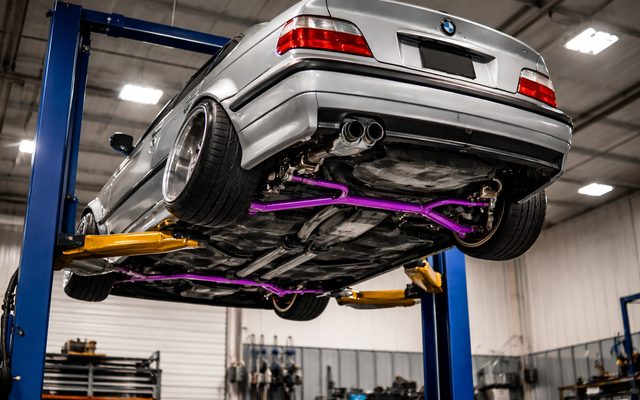
The cornerstone of any exceptional drift machine is, undoubtedly, the base vehicle itself. Several vehicles have attained renowned standing within the international sliding scene due to their natural weight distribution, strong construction, and the vast ecosystem of aftermarket parts available. Choosing the optimal starting point is the first and most significant choice a driver will make. To illustrate, the BMW E36 is universally acknowledged as among the finest overall cars for drifting of the modern era. Its near-perfect 50/50 weight distribution, combined with a RWD configuration and robust six-cylinder motors, forms a car that is at once forgiving for novices and incredibly capable in the control of a expert driver. The successor of this philosophy, the BMW E46 platform, builds upon these attributes with a even more refined frame, wider wheel track for improved confidence, and even a greater degree of turning capability straight from the manufacturer. A different dominant option in the professional circuit is the Chevrolet Corvette C6.
This V8-powered track weapon introduces a particular array of strengths to the sliding sport, such as a low-mass aluminium chassis, a backwards-positioned transaxle that helps create an excellent balance, and the immense low-end power of a powerful LS-series V8 engine. This fusion makes it an utter force on track, capable of starting and sustaining continuous slides with seemingly minimal use of throttle. For drivers looking for exceptional bang-for-the-buck, the Nissan 350Z excels as a prime candidate. It comes from the factory with a rigid chassis, a decent OEM locking differential, and the free-revving VQ35DE motor that provides plenty of performance for practicing and moving up in the activity. Its newer version, the 370Z model, offers further advancements in chassis stiffness, steering geometry, and outright powerplant performance, solidifying its place as a favorite pick among professional drivers. Other legendary vehicles that merit consideration include the agile unique Mazda FC, the most popular S13 Silvia/240SX, the V8-powered SN95 generation Mustang, the more recent E90 3 Series, and the tiny yet surprisingly engaging and teachable Mazda Miata. Each of these chassis gives a distinct array of characteristics, challenges, and possibilities, but they all possess the core ingredients necessary to serve as a serious drift machine.
However, choosing the right car is only the first step. To unlock the complete performance of any of these vehicles, major upgrades to the steering and chassis control systems are utterly mandatory. This is where the world of specialist aftermarket hardware enters sharp importance. The one most transformative modification for a dedicated drift car is the integration of a maximum-angle drift angle kit. These engineered kits, for example those developed by performance brands like SLR Speed, are created to dramatically expand the car's possible turning lock. A factory production vehicle is severely limited in how far its front wheels can pivot, a safety limitation for public road operation. In sliding, but, extreme countersteering is frequently needed to control and maintain a slide. An modification kit substitutes the OEM steering knuckles, linkages, and potentially control arms with parts that enable the steered wheels to attain angles in excess of 70 or even 80 degs, compared to a average stock angle of around 40 to 50 °.
This vastly increased steering angle gives the pilot with dramatically greater authority during a angle, enabling it to be far more straightforward to start a oversteer moment, maintain it through a long turn, and transition fluidly from one angle to the opposite. The contrast in handling is absolutely profound. Coupled with a appropriately selected modification is the equally essential enhancement to the car's spring and damper setup. Off-the-shelf or including expensive street adjustable suspension are generally not designed for the unique and harsh needs of drifting. A purpose-built system of coilovers is crucial. These specific suspension components feature specific piston tuning and spring strength that are optimized for the rapid load shifting that is characteristic of aggressive driving. When a pilot initiates a angle, the car's inertia is shifted forcefully to the outer of the corner. Correct performance coilovers handle this movement in a consistent fashion, permitting the vehicle to settle rapidly and offering the driver accurate feedback through the wheel and cockpit. They also allow for accurate tuning of ride height, damping firmness, and weight balance, which are all key parts of dialing in the vehicle's dynamics to a particular circuit or driving style. Together, a high-quality drift angle kit and a correctly selected pair of performance adjustable dampers form the undeniable physical base upon which all later refinement is based.
Once the essential hardware is installed, the next essential step in the development is the detailed tuning of the car's alignment. This is the world of car suspension tuning, a process that can seem daunting to the beginner but is, in practice, the secret to converting a set of high-performance parts into a unified and consistent whole. The most discussed parameter of suspension geometry for oversteer is undoubtedly negative camber. Wheel camber is the inclination of the wheel compared to the upright axis when viewed from the front-on of the car. If the top of the tire is tilted towards the chassis, this is referred to as negative camber. In oversteer driving, negative camber on the front axle tires is widely employed and is regarded as necessary. The reason is fundamentally tied to tire contact.
When a vehicle is going around a bend at high angles, the body leans towards the outer of the bend. This lean makes the outer front tire to lose its optimal grip area with the track surface. By introducing inward lean, the wheel is pre-tilted to account for this tilt. As the chassis leans into the turn, the tire flattens out with the road surface, maximizing its bite at the exact point when it is needed most for steering authority. Commonly, front axle camber settings for a serious sliding vehicle fall between approximately -3 degrees to as much as -5 degrees or even greater, contingent on the details of the vehicle geometry, rubber choice, and operator feel. The rear wheels also utilize negative camber, but the angles are usually more conservative and less aggressive than the front. Overly aggressive negative camber at the rear can make the car overly tail-happy and difficult to control on acceleration use, as it reduces the available grip area of the driven tires during linear throttle application. Hence, rear angles are frequently in the ballpark of -1 degree to -3 degrees, finding a delicate equilibrium between giving sufficient lateral traction to assist in initiating and holding the drift while also keeping good grip for power-down the bend. camber angle is only one component of the larger alignment puzzle, which furthermore includes toe setting, self-centering steering, and steer correction correction.
Toe setting refers to the orientation of the tires when looked at from the top. Inward toe means the front edges of the tires are nearer together than the trailing edges, while outward toe means the reverse. For sliding, a small amount of front negative toe is commonly employed to quicken the initial steering feel, making the vehicle feel more nimble and eager to begin a oversteer moment. Rear toe is generally set to neutral or a extremely small amount of positive toe to promote straight-line stability under acceleration. self-centering is the forward or aft tilt of the kingpin axis when viewed from the side-on of the chassis. Positive positive caster increases feedback and stability stability, and it additionally adds to inward lean effect during cornering, which is very useful. Adjusting these settings is a detailed interplay where a adjustment to a single value can and will impact the remaining parameters. The traditional approach for setting a vehicle's alignment for sliding has long been a time-consuming process of experimentation and feeling. A pilot or engineering group would apply a modification based on experience, run the car on track, use the driver's personal perception and feedback, and then introduce another change. This process would repeat time after time until the car felt "right" or the scheduled track session ended. This methodology is not just exceptionally wasteful in terms of hours and resources, but it is additionally fundamentally flawed.
Human sensation is a infamously subjective metric, influenced by many variables such as exhaustion, varying track grip levels, temperature, and merely the mood of the operator on that particular run. What feels "loose" on one run might feel "tight" on the following pass, leading to contradictory feedback and counterproductive adjustments. This long-standing limitation in vehicle dynamics optimization is specifically where modern technology has made its mark to completely change the process.
The development and adoption of advanced suspension tuning applications has brought about a new paradigm for engineering and perfecting high-performance drift cars. This new generation of systems, showcased by innovative systems like GripDial, work by directly recording the real-time mechanical behavior of the car as it is piloted on the circuit. As opposed to relying on personal feel, these systems suspension tuning tool collect objective metrics on critical parameters such as suspension travel, corner velocities, G-force loading, steering angle, and driver input application. This raw data stream is then interpreted by sophisticated algorithms that can graph and interpret the data in a clear format. For the very first time, engineers and crews can see exactly what the car is exhibiting at every moment of a slide. This ability transforms the whole alignment optimization procedure. Think about the specific goal of dialing in the front negative camber for a given car. As an alternative to applying a change from -3 degrees to -3.5 degrees and then running many laps to try and "perceive" a change, a suspension tuning tool can give immediate and definitive feedback. The application can display in a chart how the wheel's grip is performing during the critical phases of a drift: the initial flick, mid-corner, and changing direction. It can demonstrate if the current angle is permitting the steering tire to achieve ideal loading or if the compound is overloaded on its outer edge.
The system can then make data-driven advice for adjustment. drift angle kits Perhaps the telemetry indicates that the outside front tire is still overworking its edge at -3.5 degrees of negative camber, implying that an increase to angle, say -4 degrees, might be beneficial. On the other hand, the information might reveal that the tire is not reaching heat or that the inside shoulder is wearing too quickly, which could point to that there is overly aggressive negative camber and a slight decrease back to -3.2 degrees would be better efficient. This degree of granularity and useful analysis was literally impossible in the days of exclusively seat-of-the-pants setup.
The benefit of utilizing a dedicated suspension tuning tool reaches far beyond only optimizing camber angles. It functions as an invaluable damper adjustment manual that is tailored to your specific car. When adjusting the rebound and compression values on your adjustable dampers, rather than relying on imprecise tips or replicating another driver's setup, you can utilize the data to see how the vehicle is reacting in response to your changes. The application can graph the damper movement path over a section of track, highlighting if the dampers are controlling the weight transfer properly or if they are permitting the vehicle to bounce excessively after a direction change. It can aid in diagnosing issues like bottoming out or topping out, permitting you to make educated choices to helper springs, rebound/compression values, or ground clearance. This approach extends similarly to the intricate task of corner balancing. In addition to camber, the system can offer data into how adjustments to toe and caster are affecting the vehicle's balance during different parts of a slide. For example, it can allow you to find the best amount of front toe out for your particular angle kit geometry and piloting style suspension engineering by measuring the quickness of initial reaction and the predictability of the car at full countersteer. This transforms the system an extremely useful vehicle dynamics manual that is dynamically updated by the real-world dynamics of your specific car on the circuit. It elevates the whole process from a dark art into a methodical engineering process.
Moreover, the utility of a system like modern telemetry is not at all confined to experienced engineers with extensive resources. For the grassroots enthusiast, it serves as an amazing force multiplier. It effectively gives the driver with the insight of a professional race engineer without needing the associated overhead. It drastically shortens the tuning process by giving clear answers to challenges that would traditionally take seasons of experimentation to answer. A tuner can see how their individual car reacts to various settings, developing a more intuitive comprehension of vehicle dynamics in the endeavor. It furthermore opens up advanced suspension engineering concepts, allowing every enthusiast with the drive to optimize their car to achieve it in a structured and effective manner. This is especially valuable in a sport like drifting, where engineering expertise has traditionally been a tightly held commodity among top drivers. Now, that capability can be in the toolkit of any motivated enthusiast.
In summary, the journey to constructing and dialing in the ideal championship-contending sliding vehicle is a multi-stage project that smoothly blends proven mechanical principles with 21st-century digital tools. It commences with the wise pick of a proven platform, then built upon the installation of critical drift-spec components like drift-spec angle modification systems and expertly specified performance adjustable dampers. The process then moves into the precision phase of alignment optimization, where parameters like negative camber, toe setting, and caster angle are carefully configured to complement the chassis's modified geometry and the operator's personal needs. The final step, and what truly separates the modern approach from the old ways, is the adoption of a powerful drift telemetry software. This tool eliminates the uncertainty and waste of solely feel-based setup by providing empirical, real-time telemetry on how the car is actually performing. It acts as an incredible diagnostic aid, a actionable drift suspension tuning guide, and a all-in-one chassis development system. As a complete package, this integrated approach guarantees that every element of the drift car—from the selection of the chassis to the final click on the suspension—is refined for maximum success on the competition venue. It signifies the total maturation of the sport of oversteer driving, bridging mechanical car control with precise vehicle setup to build the most dominant machines imaginable.